
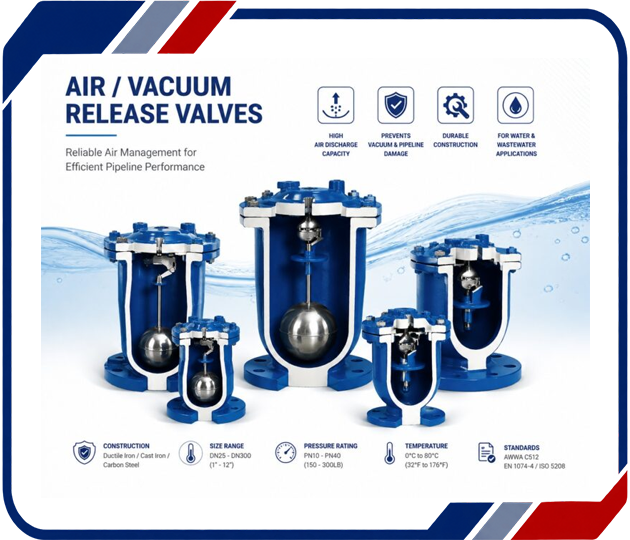
Industries / Applications
Air/Vacuum Valves are widely used in:
- Water Transmission & Distribution
- Municipal Water Supply
- Water Treatment Plants
- Wastewater & Sewage Systems
- Irrigation & Agricultural Water Systems
- Desalination Plants
- Power Plants & Cooling Water Systems
- Mining & Slurry/Process Water Systems
- Industrial Water Pipelines
Typical Materials
Material selection depends on pressure, water quality, temperature, and service conditions.
| Component | Typical Material |
| Body | Ductile Iron / Cast Iron / Carbon Steel |
| Cover | Ductile Iron / Carbon Steel |
| Float | Stainless Steel / Reinforced Polymer |
| Seat | EPDM / NBR / PTFE |
| Internal Parts | Stainless Steel |
| Bolting | Carbon Steel / Stainless Steel |
| Coating | Fusion Bonded Epoxy (FBE) / Protective Coating |
Typical Grades & Standards
Common Material Grades
- Ductile Iron: ASTM A536
- Cast Iron: ASTM A48
- Carbon Steel: ASTM A216 WCB (where applicable)
- Stainless Steel: ASTM A351 CF8M / CF8
- Stainless Steel internals: SS316 / SS304
- EPDM: Suitable for potable/utility water service
Common Design & Testing Standards
- AWWA C512 – Air-Release, Air/Vacuum, and Combination Air Valves for Water and Wastewater Service
- ASME B16.1 / B16.5 – Flange dimensions, depending on valve design
- ASME B16.10 – Face-to-face/end-to-end dimensions, where applicable
- API 598 – Valve inspection and pressure testing, where specified
- ISO 5208 – Pressure testing of metallic valves, where specified
- NSF/ANSI/CAN 61 – Materials/components for drinking-water system applications, where required
Why They Are Important
Air/Vacuum Valves are essential pipeline protection devices. Without proper air management, pipelines can experience vacuum conditions, water hammer, pressure surges, column separation, reduced flow capacity, and potentially severe structural damage.
